Test report DSG-4507 · Rev F · tested October 13, 2026
Memory & StorageDevice under test
Samsung and AMD Demo Memory Expansion to Ease AI Bottleneck
Samsung and AMD have jointly demonstrated memory expansion technology targeting the AI memory bottleneck, signaling deeper coordination between the memory giant and the chip designer.
- Read
- 3 min
- Words
- 514
- Node
- 7nm
- Operator
- Elena Vasquez
Spec summary
- Samsung and AMD demonstrated memory expansion technology aimed at easing the AI memory bottleneck
- The demo pairs Samsung's memory manufacturing base with AMD's accelerator expertise
- No production timeline or product availability has been announced yet
- The technology targets the memory wall constraining AI accelerators
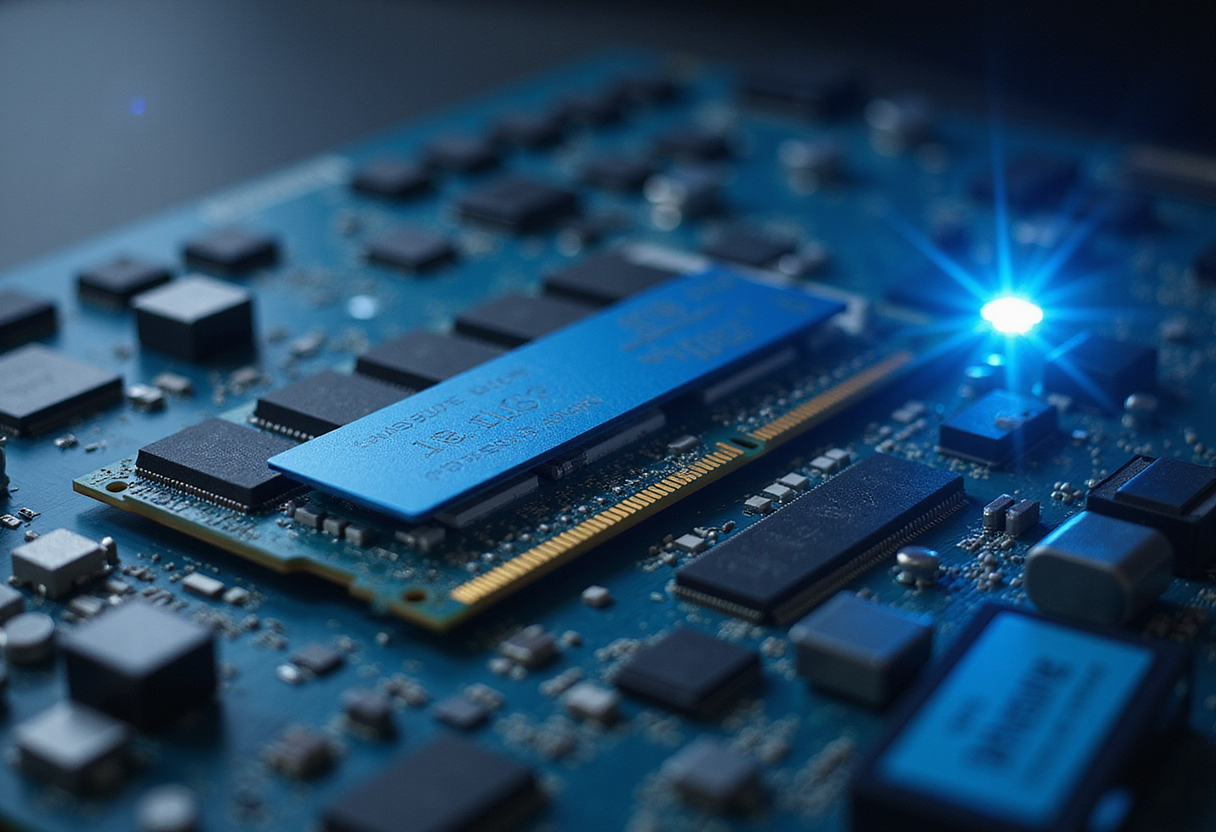
Samsung and AMD have demonstrated memory expansion technology aimed at one of the most persistent bottlenecks in AI compute: not enough memory bandwidth where the model needs it. The two companies showed the demo jointly, pairing AMD's accelerator expertise with Samsung's memory manufacturing base. For engineers sizing AI infrastructure, that combination matters more than either name alone.
The problem they're attacking is well understood by practitioners. Large language models and other AI workloads are increasingly limited by how fast data moves between processing units and memory — the so-called memory wall — rather than by raw compute. When a model can't feed its accelerators quickly enough, expensive silicon sits idle.
What does the demo actually change?
A demonstration isn't a shipping product, and it's worth keeping that distinction clear. What it signals is that two of the largest players in their respective segments see memory expansion as a competitive front, and that they're coordinating on it rather than working purely in parallel.
For Samsung, the demo extends its positioning beyond commodity DRAM and HBM supply into system-level memory architecture. For AMD, whose accelerators compete against rivals with tightly integrated memory stacks, an expanded memory envelope is a way to differentiate on capacity and bandwidth without waiting for the next process node.
For buyers and datacenter operators, the practical implication is straightforward: if memory expansion reaches production, more of each accelerator's peak compute becomes usable per dollar spent. Workloads that today require splitting models across additional cards could potentially run on fewer of them.
Why memory is the constraint now
AI workloads have shifted the economics of memory. Model sizes keep growing, and each generation of accelerator packs more compute than the memory subsystem can comfortably feed. That gap is where performance — and money — leaks away.
Memory expansion attacks the problem from the capacity and bandwidth side rather than asking the model to shrink. That's a different bet than pure software efficiency plays, and it's one memory vendors are uniquely positioned to make.
What to watch next
Demos like this typically precede productization decisions, and the open questions are the usual ones practitioners will ask:
- When does the technology move from demonstration to a roadmap commitment with a timeline?
- Will it appear first in datacenter accelerators, or does Samsung plan broader deployment across its memory lines?
- How will the expanded memory be priced relative to conventional capacity — because per-gigabyte cost determines adoption more than peak bandwidth does.
None of those questions have answers yet. What the demo establishes is intent: Samsung and AMD are treating the AI memory bottleneck as a joint engineering target, not a problem each side solves separately.
For system architects, the near-term move is to track whether this pairing hardens into a standard or stays a bilateral arrangement. Interoperability is what turns a vendor demo into something you can design around. Until then, treat this as a signal of direction — memory capacity and bandwidth are where AI hardware competition is heading, and the two companies just said so publicly.
via Google News: HBM memory (Source)
More from Elena Vasquez
Show full bio
Senior reporter covering people, launches and day-to-day practice in hardware layer of artificial intelligence at Die Signal.
306 articles
Same lot · LOT-C1C9
- DSG-759665nmSamsung Pairs CXL Memory Expansion With AMD at OCP 2026
- DSG-57873nmSamsung lays out next-gen memory strategy for AI data centers at OCP
- DSG-698228nmMicron Earnings: AI Chip Demand Drives Fresh Memory Boom
- DSG-312328nmSamsung Sets AI Memory Strategy Around HBM5, CXL and Next-Gen SSDs
- DSG-75607nmSamsung Forecasts HBM at 30% of DRAM Capacity by 2027