Test report DSG-6225 · Rev B · tested October 14, 2026
Processors & AcceleratorsDevice under test
Microsoft showcases Maia 300, its new custom AI chip
Microsoft has showcased the Maia 300, a new custom AI chip reported by TahawulTech.com, extending its in-house accelerator design line for AI workloads.
- Read
- 3 min
- Words
- 589
- Node
- 28nm
- Operator
- Marcus Bennett
Spec summary
- Microsoft showcased the Maia 300, a new custom AI chip.
- The report comes from TahawulTech.com.
- The Maia line debuted publicly in November 2023.
- The company has not published specifications, release date, or pricing for the Maia 300.
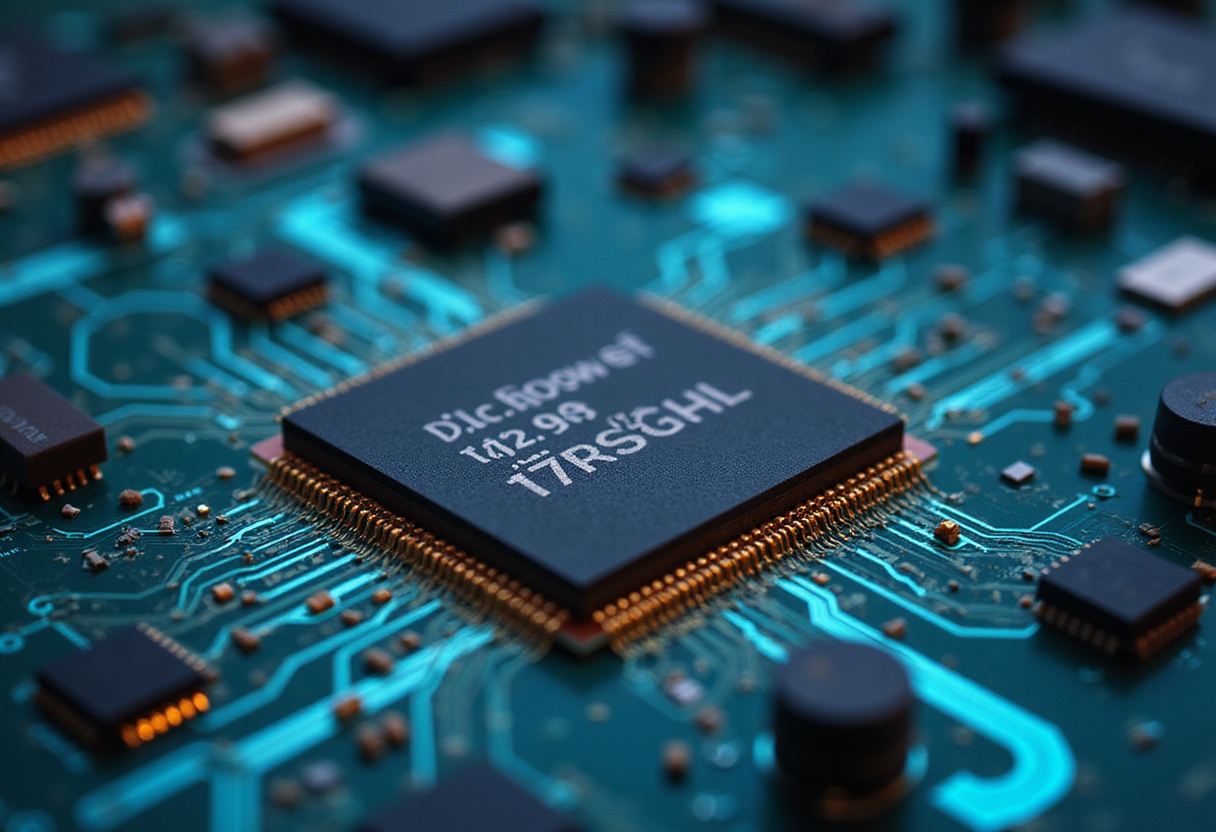
Microsoft has showcased the Maia 300, a new custom AI chip, as reported by TahawulTech.com. The announcement confirms the company's continued investment in its own accelerator silicon rather than reliance on outside suppliers alone.
The name carries weight. It follows Microsoft's Maia line of in-house AI processors, a family the company first presented to the public at its November 2023 developer event. With the Maia 300, Microsoft shows it intends to keep iterating on that design line for its AI workloads.
What is on show?
TahawulTech.com reports the showcase as a hardware debut. The Maia 300 is a custom chip, which means Microsoft designed it for its own systems and services rather than buying a general-purpose part from a merchant vendor.
Custom silicon serves one main purpose. The owner tunes the chip to the exact workloads it runs, in this case AI training and inference at data-center scale. That tuning can cut cost per computation and cut power draw per computation. Both numbers matter when a hyperscaler builds out AI capacity.
The showcase itself is a signal to the market. A company does not put a chip on stage unless it has a deployment path for it. The public display says the part has moved past the internal design stage.
What does this change for Microsoft's AI infrastructure?
The practical question is simple: what does this change for the buyers and rivals watching Microsoft? For Microsoft, it deepens control over its AI supply chain. For chip vendors, it adds a competitor with deep pockets and a captive customer. For cloud customers, the effects arrive indirectly, through pricing and capacity over time.
Microsoft has not released full technical specifications for the Maia 300 in the showcased material, according to the TahawulTech.com report. Readers should treat performance claims as unavailable until the company publishes benchmark data.
What the showcase does establish is intent:
- The Maia design line continues past its first generation.
- Microsoft keeps its custom-silicon program funded and visible.
- The company positions the chip against AI workloads specifically.
Why custom silicon matters now
The AI buildout has strained the merchant GPU market. Hyperscalers have responded by designing their own accelerators. Microsoft's Maia program sits in that movement, alongside similar in-house efforts at other large cloud operators.
The economics drive the decision. A chip tuned to one operator's models and software stack can run those models cheaper than a general-purpose part. At the scale of millions of servers, small per-chip savings become large line items.
The Maia 300 showcase also tells software teams something. A second-generation part usually means the first generation ran well enough to justify a successor. Iteration is the strongest evidence a silicon program works.
What comes next
The report from TahawulTech.com does not state a release date, pricing, or availability for the Maia 300. Those details will decide the market impact.
Watch for three follow-up markers:
- A public specification sheet with compute, memory, and interconnect figures.
- Deployment confirmation inside Microsoft's Azure cloud.
- Any benchmark comparison against merchant AI accelerators.
Until then, the showcase stands as a statement of direction. Microsoft designs its own AI chips, it will keep doing so, and the Maia 300 is the next step in that program.
For enterprises buying AI capacity, the near-term change is limited. The long-term change is structural: one more hyperscaler controls more of its own silicon stack, and that shifts bargaining power across the whole accelerator market.
via Google News: AI chip (Source)
More from Marcus Bennett
Show full bio
News editor covering regulation, policy and their impact on hardware layer of artificial intelligence at Die Signal.
361 articles
Same lot · LOT-C1CA
- DSG-55767nmMicrosoft Targets 2027 Launch for Maia 300 AI Chip
- DSG-31655nmMicrosoft Unveils Maia 300 AI Chip for Copilot and Teams
- DSG-965628nmMicrosoft Unveils Maia 300 AI Chip, Expanded Rollout From 2027
- DSG-976565nmMicrosoft Bets Big on Maia 300: Its Own AI Accelerator Moves Center Stage
- DSG-456865nmMicrosoft Unveils Maia 300, Its Next-Gen Custom AI Chip