Test report DSG-6300 · Rev A · tested October 12, 2026
Memory & StorageDevice under test
Micron Shares Fall as CXMT's Square DRAM Cell Raises Stakes
Micron shares fell after China's CXMT reported a 4F² square DRAM cell breakthrough, threatening incumbents' cost edge in commodity memory.
- Read
- 3 min
- Words
- 534
- Node
- 28nm
- Operator
- Marcus Bennett
Spec summary
- Micron stock fell after reports of CXMT's 4F² square DRAM cell breakthrough.
- The 4F² square cell design packs more bits per die than today's rectangular layouts.
- Samsung, SK hynix and Micron have not taken square cell designs to mass production.
- CXMT is based in Hefei and is central to China's push for DRAM self-sufficiency.
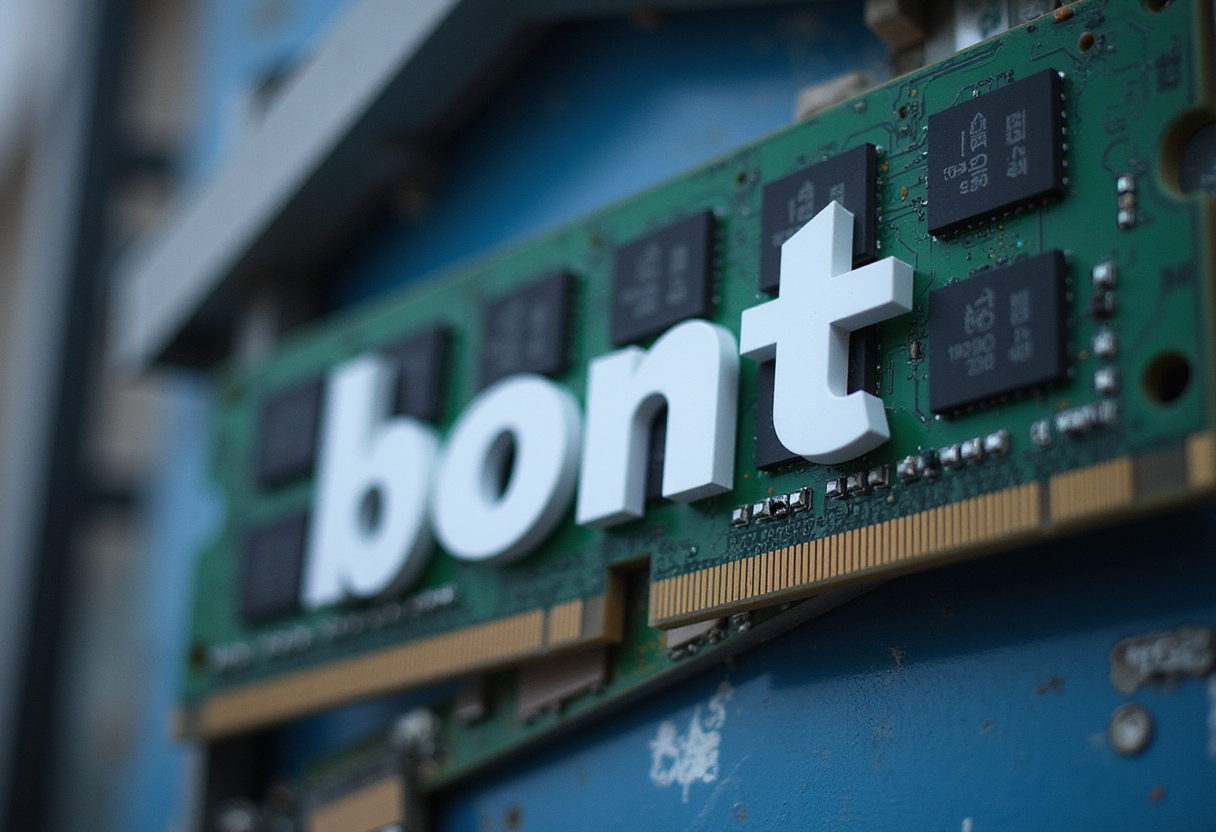
Micron's stock dropped after reports that China's CXMT has achieved a breakthrough in DRAM built on a 4F² square cell design. The move signals that the Chinese memory maker is reaching for a cell architecture the three incumbent giants have not yet put into mass production.
The market reaction was immediate. Investors read the news as a threat to Micron's cost position in commodity DRAM, and the sell-off followed. But the story is about silicon geometry, not sentiment.
What is a 4F² square cell?
DRAM makers store each bit in a capacitor accessed by a transistor. The shape of that cell determines how many bits fit on a die. Today's mainstream production uses cells laid out in rectangular arrangements. A square 4F² cell packs the same minimum feature size into a tighter footprint.
The practical consequence is density. More bits per wafer means lower cost per bit. In commodity DRAM, cost per bit is the whole game. Any producer that gets there first can undercut rivals on price and still hold margin.
The incumbent trio — Samsung, SK hynix and Micron — has long studied square cell layouts as a future step. None has taken it to high-volume manufacturing. If CXMT has made the design work at scale, it leapfrogs a generation of cell engineering.
Why did Micron shares move?
Micron competes directly against CXMT in standard DRAM, particularly in the Chinese market, where Beijing has funded domestic memory production for years. A cheaper, denser cell from CXMT would pressure pricing across the segment.
The concern is structural. Commodity memory runs on thin margins and cyclical demand. A competitor with a cost advantage does not need to win every contract; it only needs to drag average selling prices down for everyone.
That mechanism explains the stock move better than any single headline. Markets price in the risk of a price war before the product ships.
What does this change for buyers and rivals?
For now, little changes on the shelf. A cell breakthrough must survive yield engineering, qualification by customers and volume ramp before it shifts market share. Those steps take time, and CXMT has not publicly detailed its production schedule or yields.
For the incumbents, the signal matters more than the timing. Samsung, SK hynix and Micron now face a credible path where the technology frontier in DRAM no longer belongs exclusively to them. Each will weigh whether to accelerate its own square-cell roadmaps.
For memory buyers — PC and handset makers, server builders — a stronger CXMT could eventually mean more supply and lower prices, the same dynamic previous entrants produced in NAND and older DRAM nodes.
The backdrop
CXMT, based in Hefei, has expanded DRAM output steadily under China's push for semiconductor self-sufficiency. Sanctions have restricted its access to some leading-edge tools, which makes an architectural jump like 4F² more valuable: density gains from design can offset limits on process-node advances.
The question ahead is execution. Square cells are hard to manufacture at yield. If CXMT clears that bar, Micron's dip marks the start of a real contest. If it does not, this week's move will look like noise.
By Marcus Bennett
via Google News: DRAM chip (Source)
More from Marcus Bennett
Show full bio
News editor covering regulation, policy and their impact on hardware layer of artificial intelligence at Die Signal.
311 articles
Same lot · LOT-C1C8
- DSG-588314nmCXMT Targets Server DRAM With 4F² Design for 2025 Release
- DSG-549145nmCXMT's 4F² DRAM Design Signals China's Entry Into Server Memory
- DSG-240620nmCXMT Accelerates 4F² DRAM Push, Targets Year-End Server DDR5 RDIMM Launch
- DSG-68693nmCXMT Targets 4F² DDR5 Server Memory Launch by Year-End
- DSG-685865nmMemory Stocks Slide as China's CXMT Flags Denser Chip Design