Test report DSG-9079 · Rev D · tested October 13, 2026
Supply Chain & PolicyDevice under test
Chinese Firms Bought 1 Million Nvidia Gaming Chips This Year
Chinese tech firms bought roughly 1 million Nvidia gaming GPUs this year, routing AI compute demand through consumer channels that export controls barely touch.
- Read
- 3 min
- Words
- 508
- Node
- 28nm
- Operator
- Marcus Bennett
Spec summary
- Chinese tech firms bought roughly 1 million Nvidia gaming chips this year, TIKR.com reported.
- The purchases target consumer GeForce GPUs rather than restricted data-center accelerators.
- Buyers assemble the cards into training and inference clusters to work around US export controls.
- One million units is small relative to annual global gaming-GPU shipments in the tens of millions.
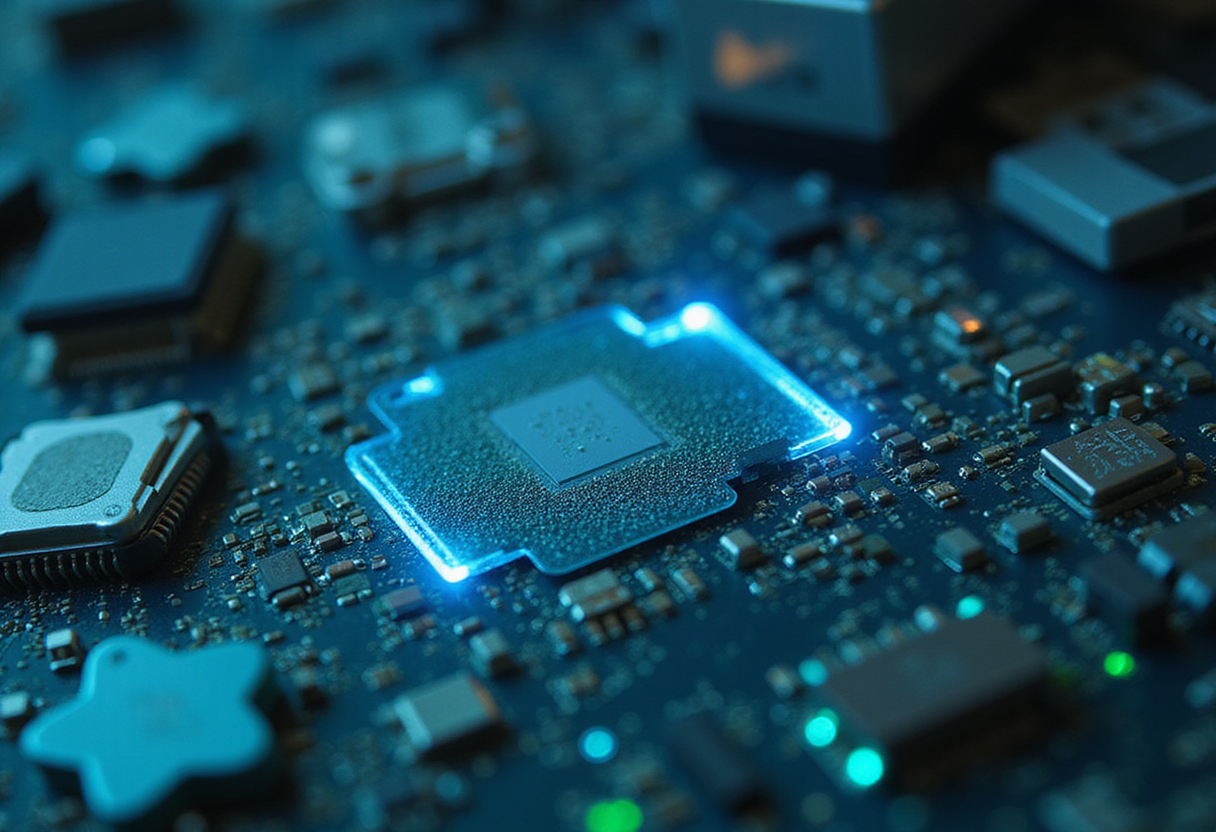
Chinese technology firms bought roughly 1 million Nvidia gaming chips this year. That figure, first reported by TIKR.com, describes consumer-grade GPUs — hardware designed for gaming rigs, not data centers — moving into commercial use across China.
The number matters because it sits at the intersection of two stories. Washington restricts sales of Nvidia's top data-center accelerators to China. Meanwhile, Chinese firms still need compute to train and run AI models. Gaming chips are the workaround that remains on the legal shelf.
Why gaming chips?
Nvidia's consumer GeForce line shares core architecture with its data-center products. A single gaming card cannot match an H-class accelerator. A cluster of thousands of them, wired together with fast interconnects, can still do useful training and inference work.
That is the mechanism behind the 1 million figure. Buyers are not building gaming cafés. They are assembling clusters from parts that export controls treat as ordinary consumer electronics.
What does this change for the AI supply chain?
It blunts the intended effect of the export regime. The rules target specific product lines. They do not fully cover the much larger market for consumer GPUs, which ships millions of units a year through retail and OEM channels that are hard to police.
For Nvidia, the sales are revenue that partially offsets lost data-center business in China. For Chinese AI labs, they are a bridge: usable compute now, while domestic accelerator programs mature.
For regulators, the figure poses a hard question. Tightening rules on consumer chips would touch a global retail market far larger than the AI segment they aim to control.
Where the chips show up
The purchases surface in several places:
- Training clusters assembled from consumer cards, running models that would otherwise wait for restricted hardware
- Inference servers doing cheaper, lower-volume serving of trained models
- Gray-market resale, with cards redistributed to smaller labs and startups outside official channels
None of these deployments match a dedicated accelerator farm in efficiency. They do not need to. The buyer's calculus is simple: available compute beats ideal compute.
The scale question
One million units is a large number in absolute terms. It is a small fraction of global gaming-GPU shipments, which run to tens of millions of cards per year. That ratio is the point. A volume that looks routine in consumer terms can materially expand a restricted country's AI compute base.
Whether the flow continues at this rate depends on policy, not demand. Chinese demand for compute shows no sign of easing. Export rules, and any future extension to consumer silicon, will decide the supply side.
What to watch
Three markers will tell the story over the coming quarters. New US rules on consumer-GPU exports, if any emerge. Nvidia's reported China revenue split between consumer and data-center lines. And evidence of Chinese buyers shifting toward domestic accelerators as alternatives reach the market.
Until then, the 1 million figure stands as the clearest single measure of how AI hardware demand routes around restrictions.
via Google News: AI chip (Source)
More from Marcus Bennett
Show full bio
News editor covering regulation, policy and their impact on hardware layer of artificial intelligence at Die Signal.
325 articles
Same lot · LOT-C1C9
- DSG-74633nmChina Faces Uphill Battle to Wean Tech Firms Off Nvidia Chips
- DSG-152245nmNvidia's China AI-Chip Share Slides as Huawei Closes Gap
- DSG-155110nmChip Smuggling Cases Reveal Gaps in Nvidia's China Export Controls
- DSG-439910nmNvidia loses AI chip share in China as Huawei closes the gap
- DSG-49517nmHuawei chairman: Ascend has passed Nvidia in China AI chip market