Test report DSG-2372 · Rev A · tested October 10, 2026
Memory & StorageDevice under test
Anthropic to Require 40 Billion DRAM Chips by 2027, 20% Direct
Anthropic will require 40 billion DRAM chips by 2027 and source 20% directly from memory makers, leaving 80% via indirect channels, per finance.biggo.com.
- Read
- 3 min
- Words
- 518
- Node
- 14nm
- Operator
- Elena Vasquez
Spec summary
- Anthropic will require 40 billion DRAM chips by 2027
- 20% of the volume (roughly 8 billion units) will be purchased directly from memory makers
- The remaining 80% (~32 billion units) will flow through indirect procurement channels
- Annual purchases imply ~13.3 billion DRAM chips per year across 2025-2027
- finance.biggo.com did not name the memory makers or specify DRAM density or product tier
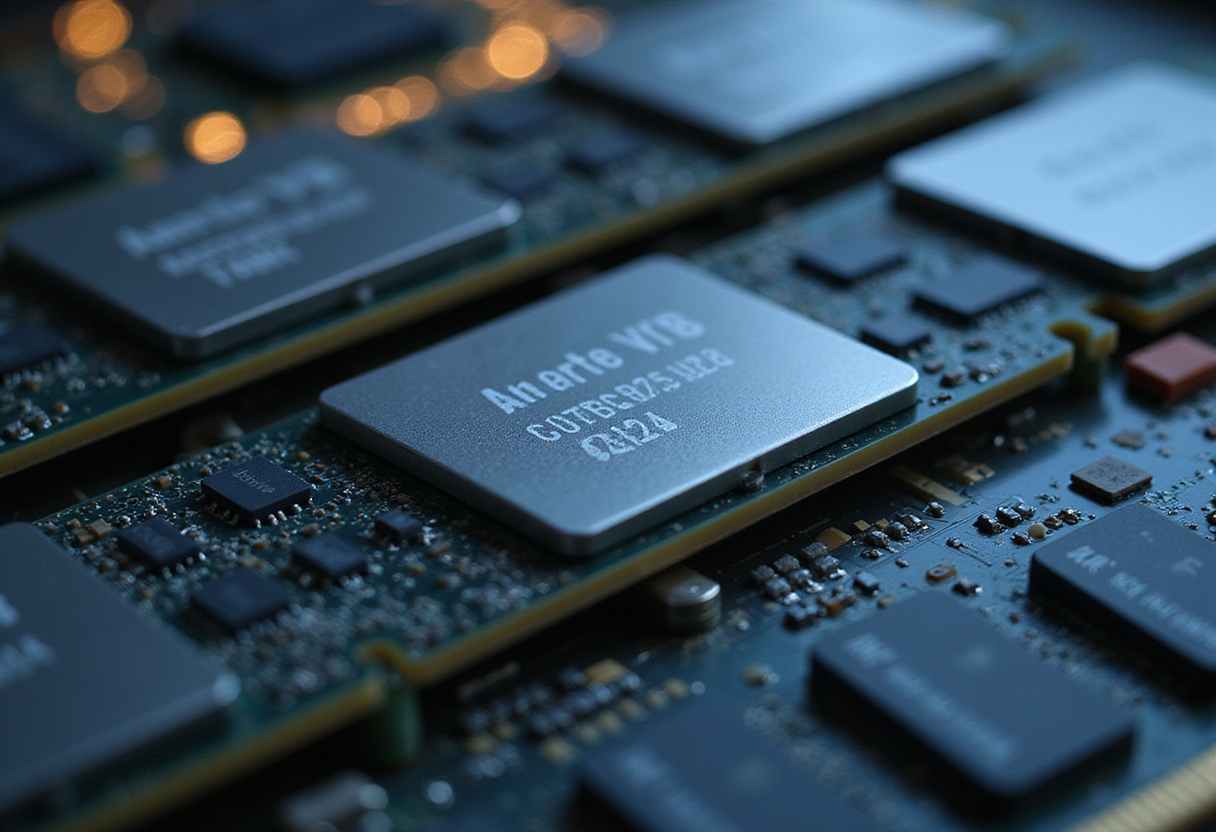
Anthropic will require 40 billion DRAM chips by 2027 and plans to purchase 20% of the volume — roughly 8 billion units — directly from memory makers rather than through intermediaries, according to a report from finance.biggo.com.
The remaining 80%, equivalent to about 32 billion units, will continue to move through the company's indirect procurement paths.
What does the direct-procurement share signal?
Memory manufacturers typically allocate production capacity to long-term direct customers before fulfilling shorter-term spot orders. By contracting for 8 billion of its targeted 40 billion units directly, Anthropic locks in priority access to fab output during periods when merchant supply tightens.
Direct contracts also typically include wafer-start commitments that fabs honour across multiple quarters, which stabilises supply when industry utilisation rates approach full capacity.
The other 32 billion units sourced indirectly give the AI lab flexibility to acquire varying densities, test grades, and module configurations that fabs typically do not sell directly to end buyers.
How does the 40-billion-unit target scale over time?
The headline figure implies average annual purchases of roughly 13.3 billion DRAM chips across the three calendar years from 2025 through 2027, assuming even scaling. That averages to about 1.1 billion units per month, or roughly 36 million units per day across the period.
Anthropic has not disclosed how the volume will ramp year over year. Memory demand from AI training and inference workloads typically grows non-linearly as model sizes, context windows, and serving fleets expand.
The breakdown suggests:
- 8 billion units under direct fab contracts (20%)
- 32 billion units via indirect channels (80%)
- 40 billion total units targeted by year-end 2027
What does the volume imply about AI compute infrastructure?
DRAM is the dominant working-memory technology for GPU servers, accelerator systems, and host CPUs that train and serve large language models. Each training cluster typically combines high-bandwidth memory on accelerator packages with conventional DRAM modules for host-attached memory and storage tiers.
A 40-billion-unit commitment by 2027 implies a corresponding expansion of compute fleet capacity, since DRAM count scales with the number of accelerator sockets and the memory footprint per socket. The procurement trajectory aligns with reported industry-wide expectations of double-digit annual growth in DRAM bit demand driven by AI workloads.
What did the report not specify?
finance.biggo.com did not name which memory makers would receive the direct contracts, what DRAM density or product tier Anthropic intends to purchase, what pricing structure applies, or whether the 40 billion figure refers to individual die units or to packaged modules.
The report also did not indicate whether the direct-purchase share will rise or fall beyond the 20% baseline as 2027 approaches, nor did it disclose contract length, renewal terms, or wafer-start guarantees attached to the direct agreements.
What to watch next?
Anthropic has not disclosed counterparties or the split of direct versus indirect spending by product tier. The next likely signals include partnership announcements with specific memory makers, public statements on accelerator fleet size, and DRAM-related disclosures during Anthropic infrastructure press events.
via Google News: DRAM chip (Source)
More from Elena Vasquez
Show full bio
Senior reporter covering people, launches and day-to-day practice in hardware layer of artificial intelligence at Die Signal.
285 articles
Same lot · LOT-C1C6
- DSG-156365nmHouse CCP Committee Presses Commerce on DRAM, AI Chip Licensing
- DSG-742010nmMicron warns global memory shortage could persist through 2028
- DSG-682365nmHBM Prices Set to More Than Double Next Year Amid Ongoing Shortage
- DSG-673814nmCXMT commits 18 billion yuan to DRAM R&D and testing capacity
- DSG-393245nmHBM Prices Set to More Than Double in 2027 on Supply Crunch